Here’s what happened.
A high-ceiling space, with fixtures mounted over 12 feet. Tight beam angle, controlled distribution. Everything looked right in the photometric file.
Then the glare complaint came anyway.
Beam Angle vs. Field Angle
What the file doesn’t show clearly is the field angle.
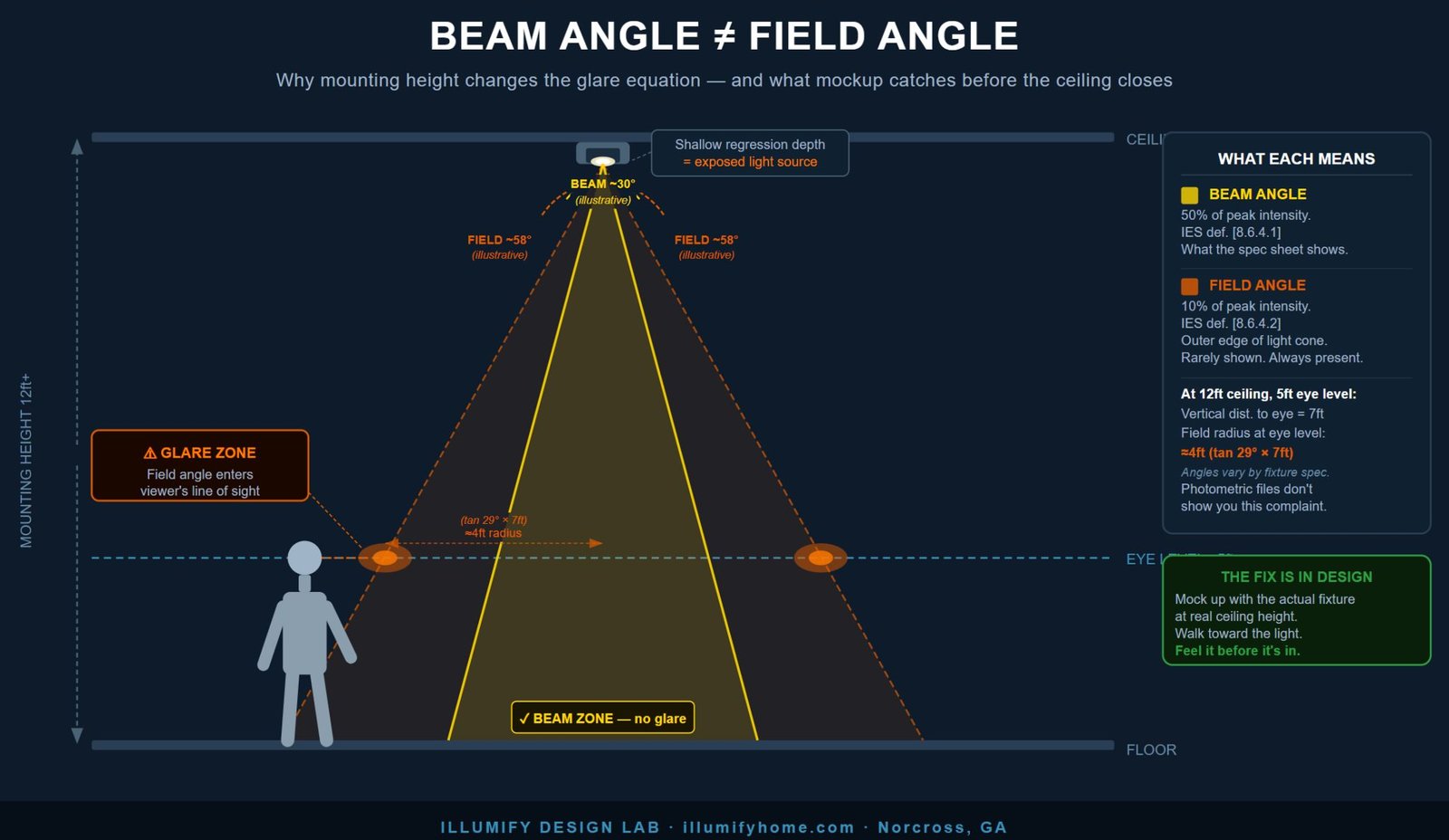
- Beam angle is where the light drops to 50% of its peak intensity — the part of the cone that does the work.
- Field angle is where it drops to 10% — the outer edge of the light cone.
On the spec sheet, the field angle barely registers. But it keeps spreading with distance. From a 12-foot mounting height, a field angle of around 60° reaches roughly 4 feet of radius by the time it gets down to eye level.
Why It Turned Into Glare
The fixture also had a shallow recess depth: the light source sat close to the ceiling plane, with very little cutoff.
The result: walk toward the fixture, and at a certain distance you’re looking straight into the source. Not the beam — the field angle. Glare, visual discomfort, and a client complaint.
The Fix — and the Better Fix
The fix was adding accessory shades on site to cut off the field angle. It worked. But it was reactive, it added cost, and it changed the fixture’s appearance — all preventable.
The better fix was a sample mockup at actual mounting height before the specification was finalized. One session with a real fixture in a real space: walk toward it, look up. If you feel it, you solve it in design — not in the field after the ceiling is closed.
That’s what our first checkpoint, Test before lock, is for, and why we mock up fixtures in the Illumify Design Lab before they’re specified. It’s also why a lower-cost substitution with the same beam angle isn’t automatically equivalent: the field angle and cutoff can be completely different.
Beam angle is the spec. Field angle is what the person in the space actually experiences.
What performance detail has surprised you on a project at installation or move-in?
Illumify is a lighting design firm led by Jared Jin, P.E., LC, MBA, based in Norcross, Georgia. We carry lighting intent from design through commissioning for architects, interior designers, builders, and owners across metro Atlanta and the Southeast. Book a free 30-minute discovery meeting · info@illumifyhome.com · 770-341-0761