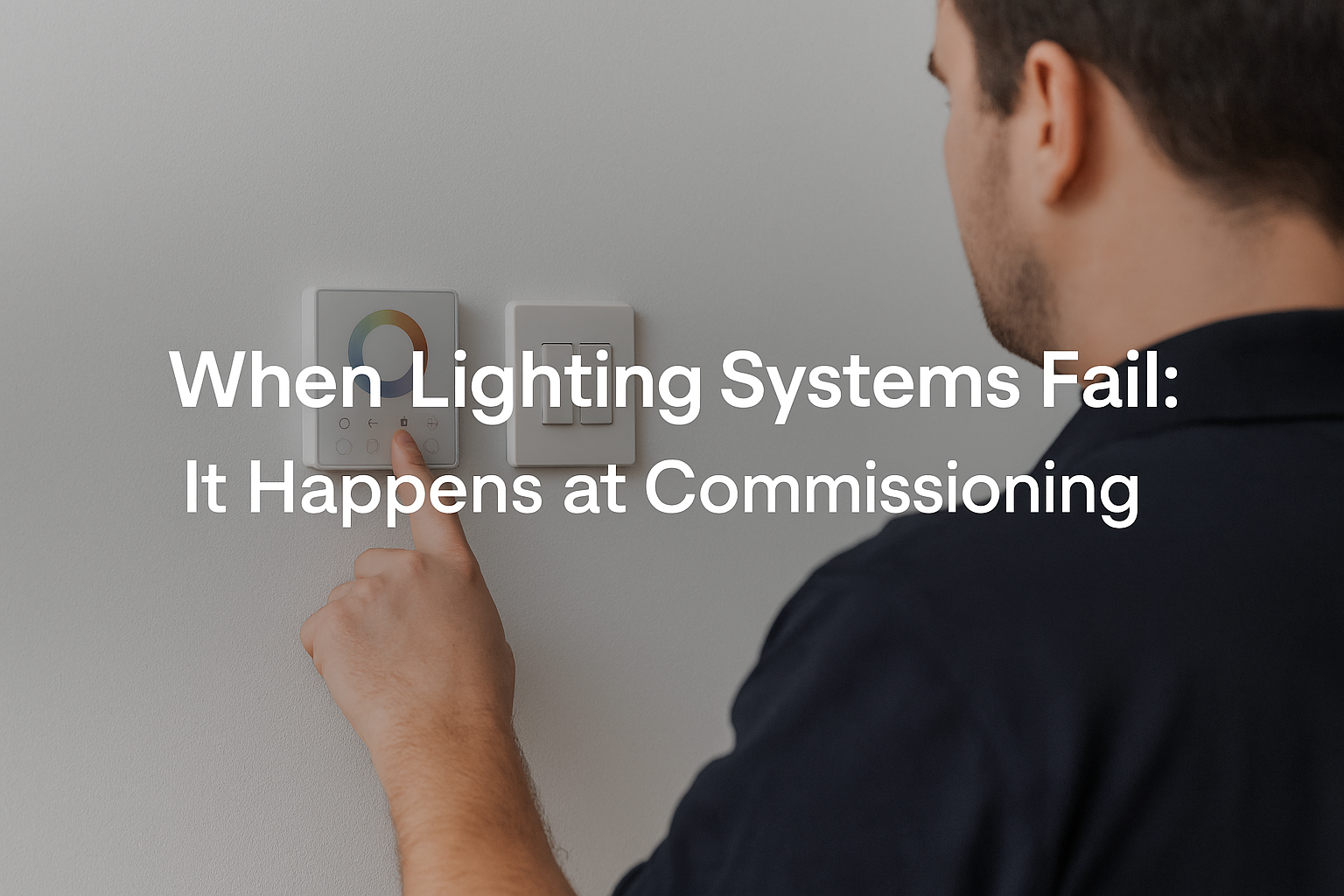
A custom home with a high-performance lighting system is only as good as the moment the owner stands in the space and experiences it.
Not the specification. Not the fixture schedule. Not the control system proposal.
The moment the lights come on and the space performs — or doesn’t.
Where Projects Lose That Moment
A tunable or full-spectrum lighting system requires more than the right fixtures and the right control platform. It requires someone who carries the technical decisions from the first design conversation through final lighting commissioning — checking that the fixtures were installed as specified, that the control sequences match the design intent, and that the system was adjusted and commissioned before the owner walks through the door.
Without someone carrying it, the gap opens quietly:
- A fixture gets substituted during value engineering without a photometric equivalence review.
- A control scene gets programmed by an electrician working from an installation manual rather than a design intent document.
- A tunable system specified to support the occupants’ daily light cycle gets set to a single static scene at move-in, because no one was there to commission it correctly.
The owner experiences the result. The builder answers for it.
That is the execution risk rarely discussed at the specification stage — and it came up during a recent CEU session on human-centric lighting at the Illumify Design Lab.
What Lighting Commissioning Actually Includes
An installed lighting system is not a finished one. Commissioning is the step that closes the difference:
- Aiming adjustable fixtures to the surfaces they were designed to light
- Setting scenes, dimming ranges, and transition timing to design intent, with the electrician or integrator
- Confirming tunable-white schedules actually change through the day
- Checking low-end dimming for flicker, stepping, or dropout
- Walking the owner through the controls and leaving a record of the settings
Continuity Is the Protection
A lighting designer does not just produce drawings and hand them off. The scope runs from concept through commissioning, with checkpoints along the way: decisions tested before they’re locked, substitutions evaluated before they’re accepted, conditions observed before the ceilings close, and the system finished before handover.
That continuity is what protects the builder’s reputation and delivers what the homeowner was shown in the design presentation.
The system performs because someone carried every decision between the specification and the switch.
If that conversation is relevant to a project currently under design, the door at the Lab is open. See how our process works, or book a free discovery meeting.
Illumify is a lighting design firm led by Jared Jin, P.E., LC, MBA, based in Norcross, Georgia. We carry lighting intent from design through commissioning for architects, interior designers, builders, and owners across metro Atlanta and the Southeast. Book a free 30-minute discovery meeting · info@illumifyhome.com · 770-341-0761