The brightest light source in most custom homes isn’t on the lighting plan.
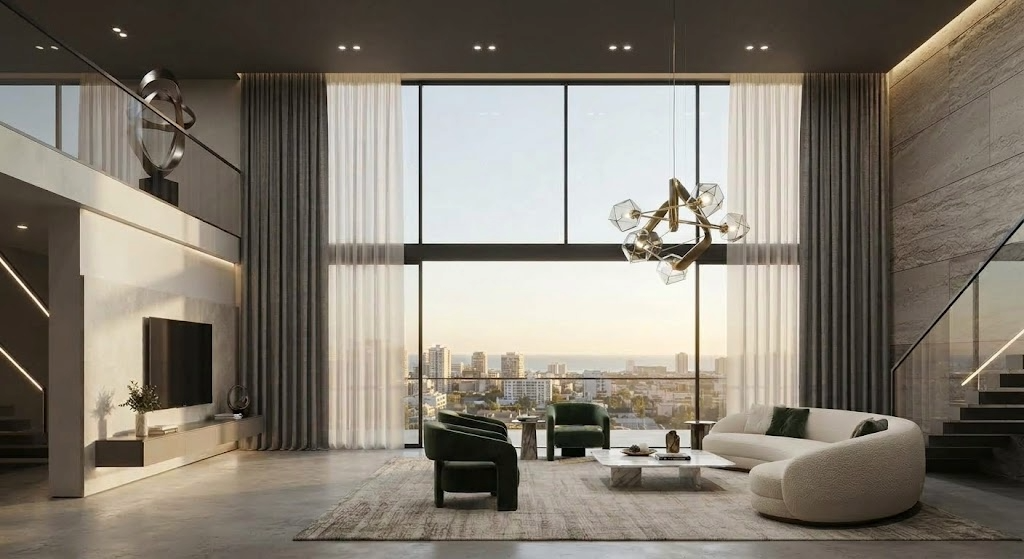
It’s the floor-to-ceiling window.
Every downlight, cove, and sconce is carefully designed and documented. But daylight — often the most powerful light in the space — is frequently treated as a separate scope and coordinated late in the project, through window treatments selected after the lighting is already set.
What Homeowners Discover After Move-In
- The room feels dark at 2 PM. Next to bright glass, the interior looks dim by comparison, so every light gets turned on in the middle of the day.
- Glare shows up where no rendering predicted it — on TVs, countertops, and work surfaces, at certain times of day and certain seasons.
- After sunset, the windows become black mirrors, reflecting the lit interior back into the room.
- Shade pockets and power were never coordinated before rough-in, so shades end up surface-mounted or wired as an afterthought.
- Lighting and shades run on separate systems, so a single “evening” or “movie” scene can’t control both.
This isn’t just a window treatment issue. It’s lighting design.
Why Daylight Belongs in the Lighting Design
Daylight changes everything around it. It sets the brightness the eye adapts to, so electric light that looks right at night can look weak at noon. It shifts color through the day, so warm 2700K interiors can read yellow next to midday sky. And glazing itself changes the light that comes through: tinted and low-e glass alter both the amount and the color of daylight reaching the room.
The night problem is lighting too. Windows turn into mirrors when the interior is much brighter than the view beyond the glass. Dimming interior light near the glass, and lighting the landscape or terrace outside it, brings the two closer together so the view comes back — one more reason landscape lighting and interior lighting should be designed as one scene.
What Effective Coordination Requires
- Daylight analysis by orientation. Shade fabrics, openness factors, and colors should be selected based on actual solar exposure, glare conditions, and views — a west-facing family room and a north-facing study need different answers.
- Early coordination of shade pockets, power, and mounting. These belong on the reflected ceiling plan and electrical drawings before rough-in, alongside the lighting — not after the drywall is up.
- One integrated control strategy. Shades manage daylight and glare, electric lighting responds as conditions change, and a single scene controls both.
Automated Shades Are Being Specified. Who’s Making Them Work With the Lighting?
The industry is already moving in this direction. According to Lutron’s 2026 Trend Report, 59% of affluent homeowners say daylight is as important as electric lighting, and 56% of residential designers and architects report including automated shades in their final designs.
So automated shades are increasingly on the drawings. The open question on most projects is who coordinates them with the lighting — the pockets, the power, the fabrics, and the scenes — from design through commissioning.
At Illumify, daylight is part of the lighting design, not a separate scope. We consider orientation and glazing in the lighting concept, coordinate shade pockets and power with the reflected ceiling plan, test shade and lighting scenes together on the control platforms in the Illumify Design Lab, and set them as one system at commissioning. If we’re designing the visual experience of a space, daylight belongs in that conversation from day one.
Daylight and shade integration is also one of the topics in our CEU program for architects and interior designers.
Illumify is a lighting design firm led by Jared Jin, P.E., LC, MBA, based in Norcross, Georgia. We carry lighting intent from design through commissioning for architects, interior designers, builders, and owners across metro Atlanta and the Southeast. Book a free 30-minute discovery meeting · info@illumifyhome.com · 770-341-0761