

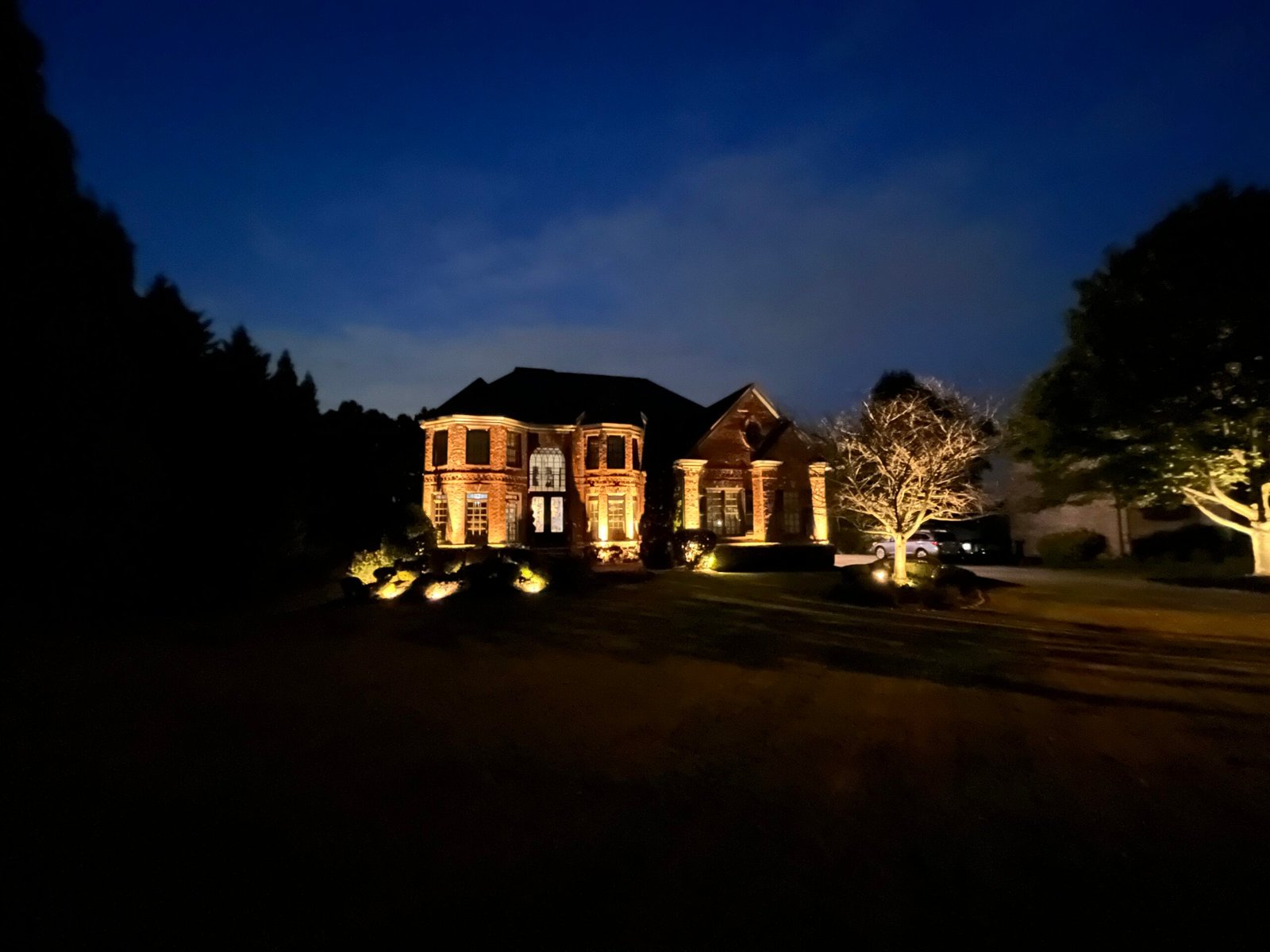
Good landscape lighting isn’t about how many fixtures you add. It’s about what you choose to leave dark.
When people picture landscape lighting, they often picture more — more fixtures, more brightness, more coverage. But a property lit evenly, corner to corner, reads flat and lifeless at night. The eye has nowhere to land. On this residential estate in metro Atlanta, the goal wasn’t to light everything. It was to build depth: to give the grounds structure, hierarchy, and a genuine sense of arrival that only exists after sunset.
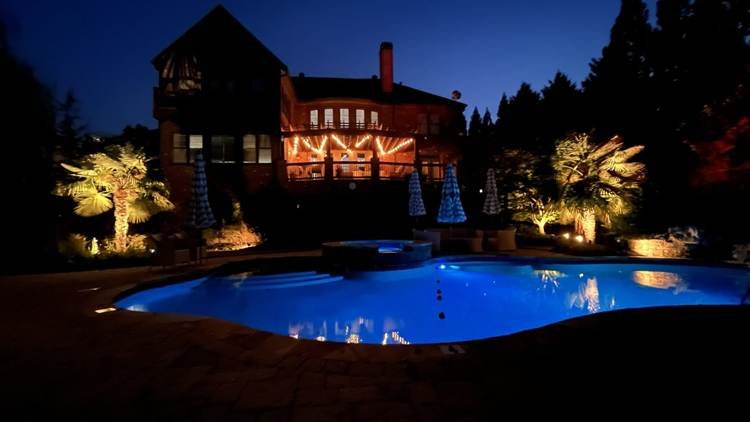
The rear elevation, reading as a single composition — architecture, planting, and water lit as one.
Lighting as subtraction
The most useful tool in a lighting designer’s kit isn’t a brighter fixture — it’s shadow. Contrast is what gives a night scene its drama. A tree glows because the space around it is dark. A façade gains texture because the light rakes across it instead of flooding it. Every decision on this project started with the same question: what deserves attention here, and what should quietly recede?
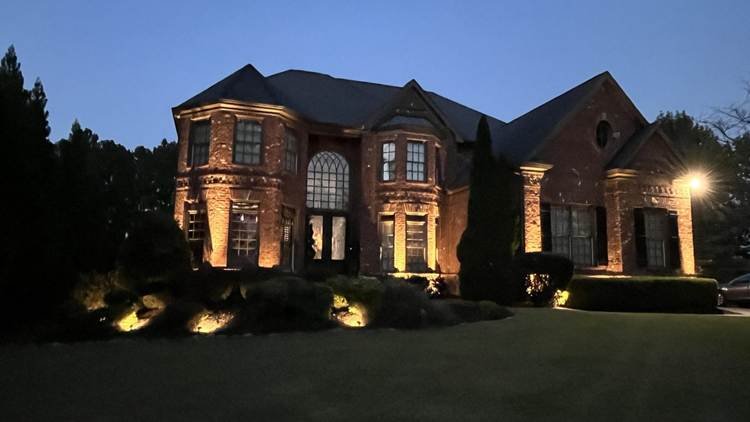
Façade grazing — warm light drawn up the brick to reveal texture, not wash it flat.
Building the layers
A finished night landscape is really several layers working together. We treated each one deliberately. Specimen trees were uplit to reveal canopy structure and branch character — the architecture of the planting, not just its silhouette. The architecture was grazed to bring out the brick and stonework. Water and stone — the pool, waterfall, and rockwork — were handled as their own layer, with color introduced intentionally rather than by default. And the gathering spaces — patios, the fire feature, the walkways — were lit for how the family actually moves through the grounds at night.
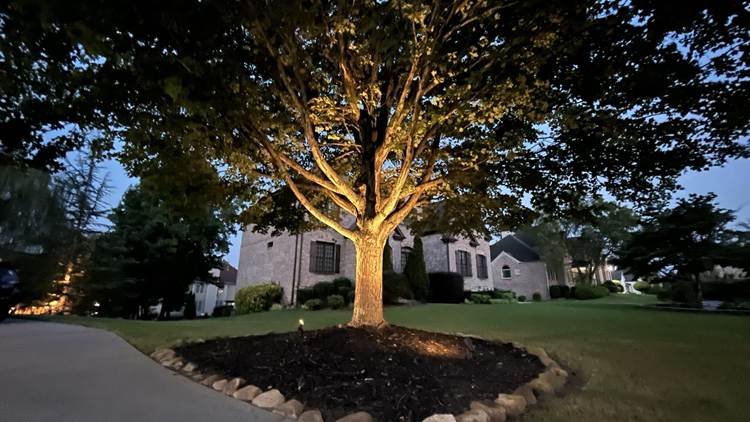
A specimen tree uplit to show canopy depth against the dusk sky.
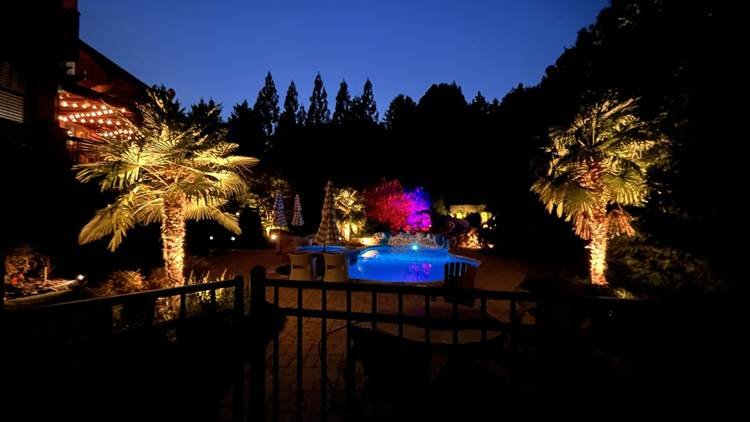
The pool framed by uplit palms under a deep blue night sky.
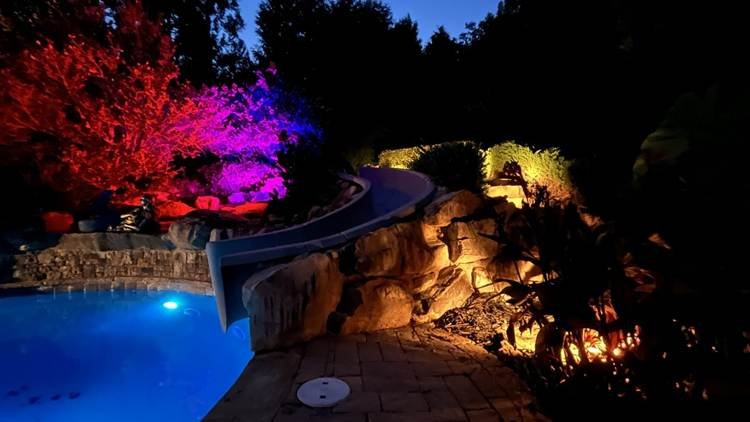
Water and stone as their own layer — color used with intent, not as decoration.
A note on color: saturated color is easy to overdo. Used sparingly and only where the setting invites it — moving water, a rock feature — it adds drama. Everywhere else, warm white does the quiet, disciplined work that makes a home feel like a home.
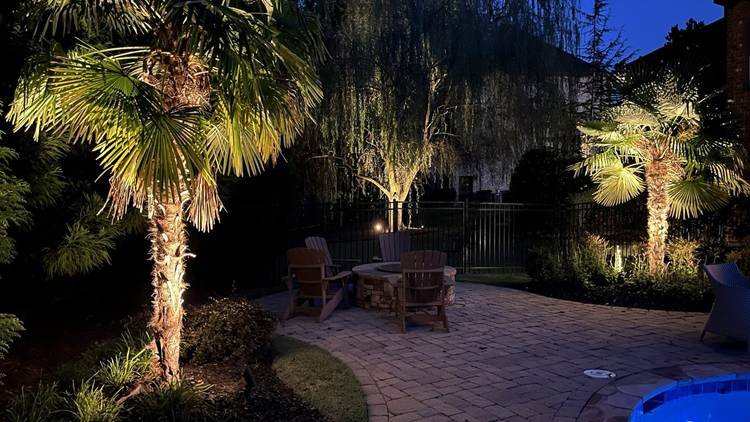
Gathering spaces lit for how the grounds are actually used after dark.
Why we commission at night
Here’s the part that separates a lighting design from a box of fixtures: none of it is finished until it’s aimed in the dark. Beam spread, glare control, the exact angle that reveals a trunk without blinding a guest on the patio — those calls can only be made on-site, at night, with the system live. We walk the property after dark and dial in every fixture until the scene reads the way it was designed to.
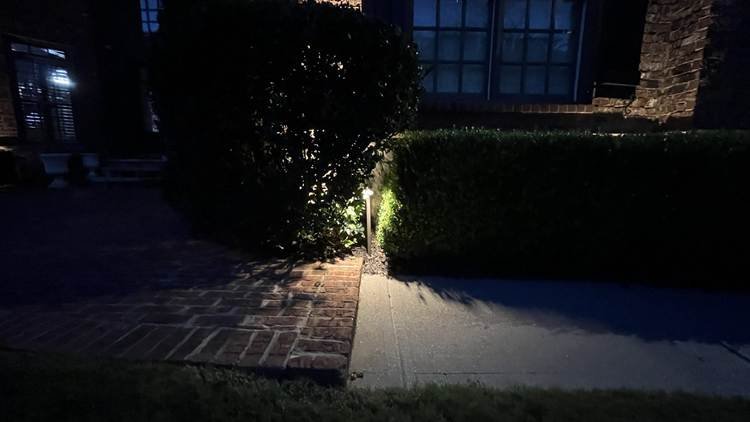
Path lighting kept discreet — you see the way, not the fixture.
The result is a property that does something it can’t do in daylight: it composes itself. Architecture, planting, water, and the spaces in between resolve into one intentional picture — the kind you only get when lighting is treated as design from the first sketch to the last night on-site.
More from the project
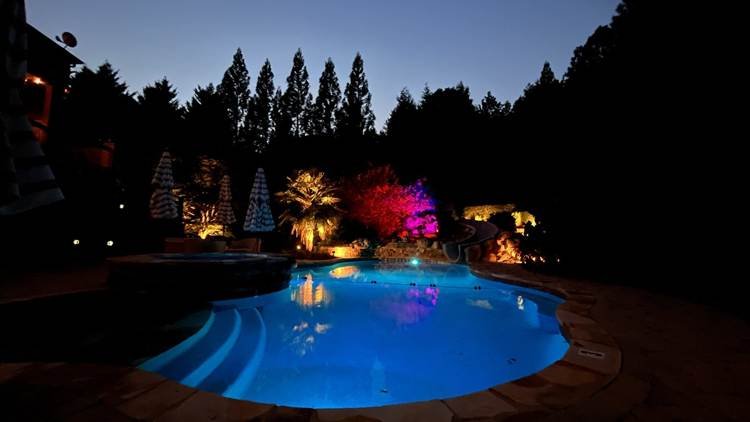
The poolscape at night, with color-accented planting reflected in the water.
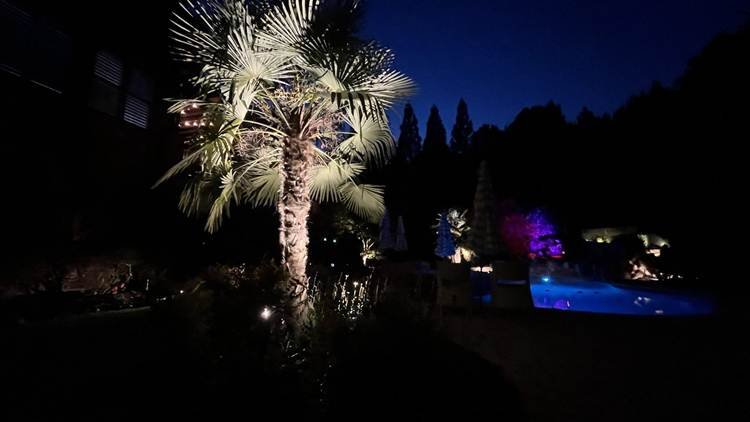
A palm grazed with white uplight beside the lit pool.
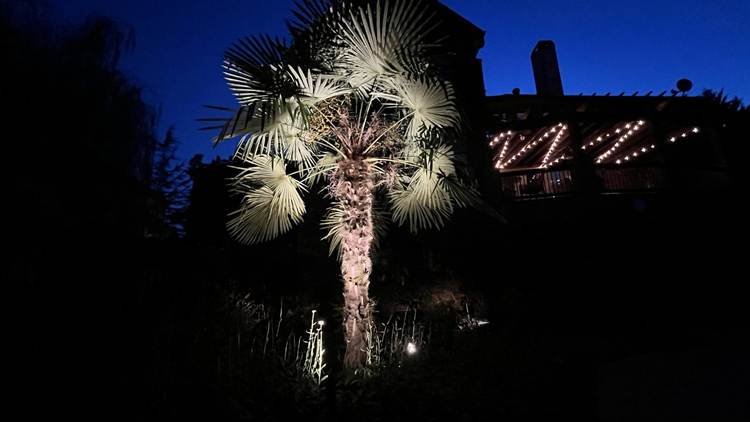
Palm uplighting paired with architectural roofline accents.
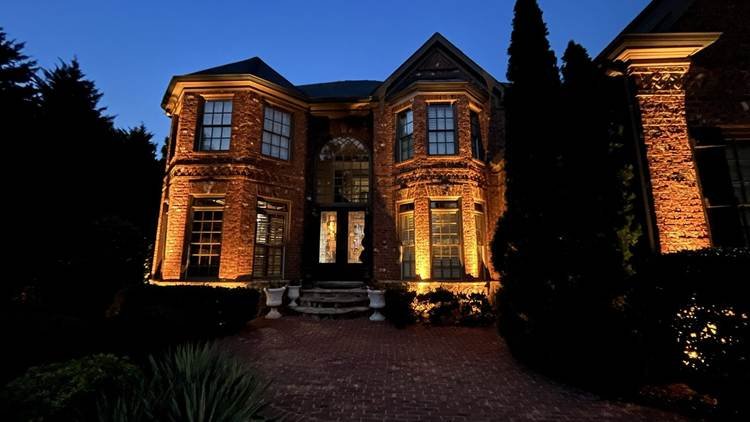
A three-quarter view of the façade, warm light and a lit entry.
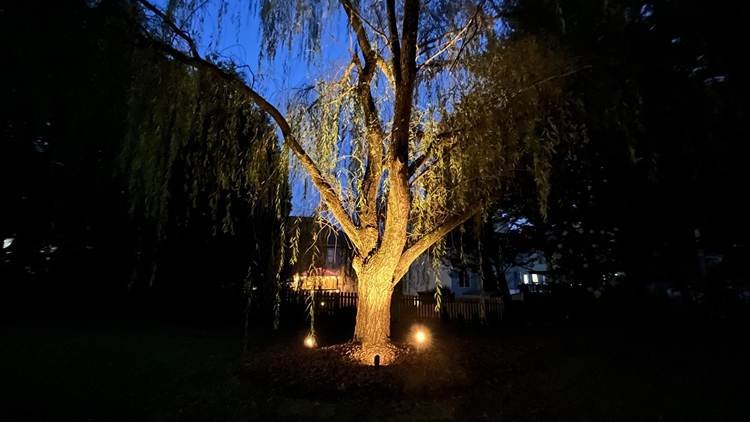
A weeping willow uplit to highlight its cascading branches.
Thinking about lighting your own project?
Illumify is an architectural lighting design & engineering firm serving the Atlanta area — residential and commercial. Book a 30-minute consult: tinyurl.com/illumify30min
Web: illumify.net · Email: j.jin@illumify.net · Phone: 770-341-0761
Designed & commissioned by Illumify — Design Lab & Experience Center · Norcross, GA